
How Hamden Busted Mugshots Begin
Every Hamden busted mugshot begins with an arrest by the Hamden Police. At the station, officers log a name, fingerprints, the alleged offense, and the processing details. Then comes the photograph that anchors the file. The picture gets the attention. The booking record around it carries the facts. Where that record lives is less obvious. Hamden sits inside New Haven County on a map. Yet Connecticut has no elected county sheriff, no county government running jails, and no county lockup at all. The state folded jail duties into one correction department years ago. It later did away with the high sheriffs entirely. So a hunt for a "Hamden County jail roster" or a "New Haven County sheriff inmate list" chases offices that simply do not exist.
Local police custody and state custody are different things, too. Someone booked at the Hamden station can walk out on a promise to appear, non-surety terms, or a bond. That person still has both an HPD arrest record and an open court case. Nothing shows up with the Department of Correction in that situation. If a judge later remands the person, CT DOC opens its own admission record and assigns a facility. New Haven Correctional Center sits close by and serves the Meriden court. Even so, the place of arrest does not decide the placement.
Fields in a Hamden Arrest Record
Don't expect one public booking-card screen with a tidy list of fields. There is no such thing here. An HPD file, a CT DOC admission, and a Judicial Branch docket are three records built for three purposes. Each holds what its creators needed. Connecticut's arrest-disclosure rule sets a floor while a prosecution is pending. Other material depends on what exists, what gets redacted, and what the law exempts. A narrow request beats a demand for "everything" every time.
| Record field | What it can show |
|---|---|
| Arrest identity | Name and address, with other identifiers used to distinguish the correct person. |
| Arrest facts | Date, time, place, arresting agency, and incident or case number when recorded. |
| Charge as booked | The offense alleged at arrest. It is not the final disposition. |
| Processing material | Fingerprints, intake details, and a booking photograph if one was made and retained. |
| Custody and bond | Release terms at the police stage or, after DOC admission, status, location, and bond fields. |
| Court record | Docket number, charges, court events, case status, and a public disposition when available. |
So what does the law actually require? Section 1-215 spells out the minimum. During a pending prosecution, the public record of arrest must include the arrestee's name and address, the date, the time, and place of the arrest, and the offense charged. The statute also guarantees access to at least one arrest report, incident report, news release, or similar record, within lawful limits. An HPD file may hold much more. Still, the presence of a field in a file never makes every part of it public.
Request Hamden Busted Mugshots Directly
For a search tied to one person, the dependable route runs straight through the Hamden Police Records Division. Connecticut FOI guidance asks for no special form. A written request does the job. The Town of Hamden FOI route can help route it to the right desk. One caution on wording matters here. Ask for existing records only, because an agency has no duty to write a new report or to answer research questions for you.
- Give the full name, a narrow arrest-date range, and the incident number if known. Add date of birth only when needed to identify the right person.
- Request the public arrest information and the arrest or incident report as separate items. Cite Conn. Gen. Stat. § 1-215.
- Ask separately for the booking or processing photograph, “if one exists,” and request electronic delivery.
- Request all reasonably segregable public portions. If anything is withheld, ask for the statute supporting that decision.
- Confirm the cost before copies are made. HPD publishes no verified photo-specific price or guaranteed completion time.
2900 Dixwell Avenue
Hamden, CT 06518
Main and non-emergency: 203-230-4000
Access has to be prompt, but "prompt" stretches or shrinks with the request itself. Silence for four business days can count as a denial for appeal purposes. That is not a promise of production in four days. Paper copies of general municipal records may run up to $0.50 per page. Electronic media can follow separate actual-cost rules. Nail down the format, the fee, and the delivery estimate before ordering anything.
Question: If no mugshot appears online, does that mean no photo was taken? Not necessarily, since Hamden Police runs no public booking gallery, and a photo in the agency file can still fall under exemption, erasure, or retention rules.
Note: HPD policy routes records through its Records Division, but that internal workflow is not an online publication schedule.
What Hamden Busted Record Copies Cost
What does a Hamden busted record copy cost? HPD has never published a verified flat fee for a booking photograph, so nobody can quote you a firm number in advance. The general municipal rule caps paper copies at $0.50 per page. Electronic records or other media follow their own actual-cost math. That ceiling tells you nothing about the price of one photo in one format. The smart move is simple: ask Records to estimate the charge first, and pick electronic delivery when it fits the record.
The same fuzziness applies to timing. Connecticut FOI law says agencies must respond "promptly." That word sets no single turnaround for every case. Scope, redaction work, where a record sits, and the agency's current workload all shape the wait. A nonresponse after four business days may be treated as a denial for appeal purposes. That window is still not a guaranteed deadline. The Connecticut FOI Commission's guidance lays out the full request and appeal framework for anyone who wants it.
Connecticut Mugshot and Erasure Law
Connecticut never built an official statewide mugshot gallery. There is no verified pay-to-remove statute aimed at booking photos, either. What the public can see instead flows from the Connecticut Freedom of Information Act, with §§ 1-210, 1-212, and 1-215 doing most of the work. Statutes elsewhere shield witnesses, victims, juveniles, and sealed material. They also let agencies withhold facts that could damage a live enforcement matter. An adult arrest on file does not unlock the whole investigative record behind it.
Clearing a record works through several doors. Section 54-142a covers erasure after acquittal or dismissal, after a nolle sits for its statutory period, after an absolute pardon, and in other listed situations. Clean Slate carries its own eligibility rules for certain convictions. Pardon applications go to the Board of Pardons and Paroles. One catch deserves attention. A photo or fingerprint item standing apart from the formal charge may need its own agency review, so nobody can promise that erasing the charge physically destroys every image tied to it.
Juvenile arrests sit outside the adult disclosure floor entirely. Youthful-offender matters never appear in the public court or DOC tools either. Treat that gap as a legal line, not a hole some archive should fill. What HPD keeps follows state municipal retention schedules, local preservation rules, and any hold tied to litigation, an audit, an investigation, or a FOI request. An old record might still sit with police. It might have been legally destroyed. It might be gone because the case itself was erased.
Corrections start with the official disposition and the source publisher. RecentlyBooked posts a no-fee correction and removal policy, and Mugshots.com spells out qualifying requests in its Record Maintenance policy. Their regional cards are unofficial no matter what. Check the official records first. Then use those free channels. Skip any paid removal broker. Once the source corrects or pulls a page, a search engine's own outdated-content process can address the stale result.
Why Some Hamden Busted Records Stay Private
Some Hamden busted records stay closed by design. Connecticut's adult disclosure floor does not reach juvenile arrest material. Juvenile proceedings carry strong confidentiality protections. HPD policy also gives those files heightened security. Youthful-offender cases never appear in the public court lookup. They are left out of the CT DOC inmate search too. So treat a missing result as a legal limit, not a failed search.
Third-party archives cannot rebuild what the law protects. The same principle covers sealed facts and erased cases. It covers protected victim details as well. Redactions tied to witness safety or an active investigation fall under it too. Ask the official custodian what may lawfully be released. Then respect the answer. That includes the no-acknowledgment response erasure law can require.
When Hamden Busted Records Can Clear
Each of Connecticut's clearing routes runs on its own clock. A nolle usually must sit for 13 months before statutory erasure kicks in. Eligible Clean Slate misdemeanors generally use a seven-year period. Eligible Class D or E felonies, plus certain unclassified ones, generally use ten. Finishing the sentence matters. So does having no pending Connecticut charge. Plenty of offenses are excluded outright.
For an absolute pardon, eligibility generally opens three years after the most recent misdemeanor disposition. The window is five years after a felony one. No pending case or active supervision is allowed either. Meeting a waiting period never guarantees relief. The clocks cannot be blended into one universal removal date. Match the case to its proper channel, whether court, Clean Slate, or pardon. Confirm the current rules before filing anything.
Does Erasure Delete a Hamden Mugshot?
Not always. Connecticut separates records tied to the formal charge from a stand-alone photo or fingerprint item. That item may carry no charge reference at all. Erasure obliges police, prosecutors, and courts to treat qualifying case records as erased. Still, promising automatic physical destruction of every image goes too far.
Ask HPD to review the specific photograph once the disposition or erasure is documented. Its record series matters here. Retention schedules can shape what the agency keeps. A local preservation rule can too. So can a valid legal hold. A publisher correction is its own separate step. De-indexing from search follows only after the live source is fixed or removed.
Find Hamden Busted Mugshots Officially
Follow custody, not a name box. One person can show up in an HPD file. Later they may appear in a court docket. Eventually they can land in CT DOC data. Each system answers a different question. A zero result in any single system settles nothing about whether an arrest happened.
- Check the Hamden Police news feed for a selected public release. Omission means only that no chosen release was found.
- For a complete person-specific local inquiry, request the arrest record and processing photo from HPD Records.
- Search the Judicial Branch pending and disposition tools after the case is entered. Hamden criminal matters currently route to G.A. 7 at Meriden.
- Use the CT DOC locator only when state admission is plausible. Read “Accused” and “Sentenced” status literally.
- Use BOP or ICE locators only for their separate federal or immigration custody populations.
The court lookup can trail the arrest by a day. Its online entries only run through the prior business day. The docket still matters most for what came after booking. It can reveal a changed charge. It can show a later court event or a disposition. An early police release simply cannot supply those.
Where Hamden Busted Mugshots Appear
Start with official channels. News coverage can point you toward a lead. Regional publishing sites can too. Neither replaces the agency file or the final court record. Their county labels fit Connecticut badly, because no New Haven County sheriff exists to publish a county roster.
| Channel | Photo status | Use and limits |
|---|---|---|
| HPD records request | Ask if a processing photo exists | Official local arrest source; disclosure is case-specific. |
| HPD selected news | Occasional agency or suspect image | Official but event-driven, not a complete feed. |
| CT DOC locator or request | DOC may provide a photograph | Official only after state admission; not a Hamden arrest archive. |
| Judicial case lookup | Not a mugshot service | Official path to pending case data and disposition. |
| Hamden Patch | Varies by story | Unofficial event coverage; not a booking ledger. |
| RecentlyBooked | Image slots may appear | Unofficial regional page with unverified provenance and incomplete coverage. |
| Mugshots.com | Historical images | Unofficial regional archive whose visible filters were historical, not current. |
Busted Newspaper, Arrests.org, and Mugshots.zone have no real Hamden or Connecticut section. Don't mistake their general homepages for local booking sources. The two regional sites that check out come with their own flaws. Listings can sit stale, attach the wrong person, or trail behind an erasure. Bring any name and date back to HPD. Then match it to the court docket before you trust what those sites display.
Hamden Custody Uses the State Locator
Hamden keeps no jail roster of its own. Connecticut runs a single state correction agency. It handles pretrial detainees admitted to DOC and people already sentenced alike. That puts the CT DOC inmate locator in an odd middle ground. It reaches deeper than a prison-only database would. Even so, it can't match a true Hamden arrest log. Someone booked at the police station and released may never appear there at all.
| Search or result field | Meaning |
|---|---|
| CT inmate number | The best search key when known. |
| Name and date of birth | The alternate identity route when no inmate number is available. |
| Status | Distinguishes “Accused” from “Sentenced.” |
| Admission and location | Shows the latest admission and current assigned facility. |
| Offense and bond | Shows a controlling offense and bond data, not a complete final case history. |
| Sentence, release, parole, detainer | Displays applicable dates and custody constraints when public. |
How current is the data? DOC refreshes its public information daily through a nightly OBIS feed, though a person's status can shift within hours. Keep in mind that youthful-offender details and ICE holds fall outside the system. A failed search can mean many things: no state admission happened, the person was released, a name got misspelled, identities crossed, or the timing was simply off.
Looking for someone right now? Search by number, or by name plus birth date. Read the status field with care, then confirm the controlling charge in court. The official DOC inmate information page spells out the system's scope and limits.
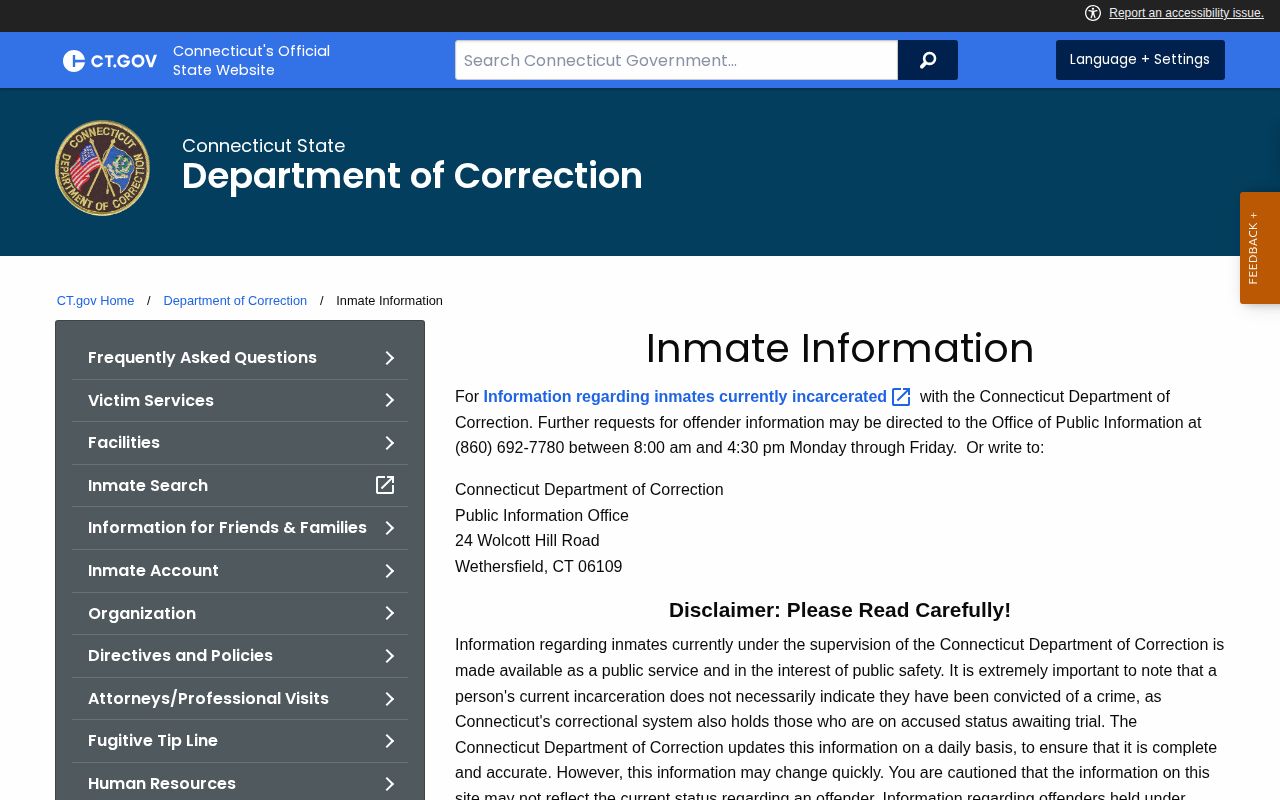
The locator works well for state-custody searches. It will never look like a Hamden booking gallery, though. DOC says a photograph counts as information it may release. Just don't expect an image attached to every result.
Busted Recently in Hamden
Want a fresh Hamden booking feed? None exists. There is no same-day, 48-hour, 72-hour, or weekly public log, and HPD only posts selected event releases rather than a full blotter. No sheriff booking app and no Hamden jail app fill the gap either. That gap is structural, and it does not make a commercial regional feed official.
| Time or custody window | Official source | What it means |
|---|---|---|
| Same day or 24–48 hours | None complete | Call HPD when temporary custody must be confirmed; request the local record. |
| 72 hours or weekly | None complete | No official multi-day Hamden blotter was located. |
| Selected incidents | HPD News | Event-driven releases can persist, but do not represent all arrests. |
| State custody | CT DOC | Daily data starts only after DOC admission. |
| Court follow-through | Judicial lookup | Entry through the prior business day; not a booking feed. |
Here is what actually happens behind the scenes. Records head to the HPD Records Division each weekday morning, and at other times when agency policy calls for it. That internal routine is not a promise that anything gets posted publicly. Weekends bring no documented surge of new material. When you need current information, pair a police records request with a court search, and turn to DOC only if the person was remanded.
Note: No result in the selected-news archive, court screen, or DOC locator proves only that the named source returned no match.
Hamden Booking Stages and Records
The database you need depends on custody stage. Booked, released, and sentenced are three different situations. They aren't interchangeable labels. Moving from one stage to the next won't erase a record either, so treat each status as its own trail to check.
| Person’s stage | Best source | Key limit |
|---|---|---|
| Just arrested or at HPD | HPD and its records staff | No public station-custody roster. |
| Released before remand | HPD record and Judicial docket | Usually no DOC result. |
| Remanded while accused | Judicial docket and CT DOC | “Accused” does not mean convicted. |
| Sentenced to DOC | CT DOC and final court disposition | Controlling offense is not the full case file. |
| Federal or immigration custody | BOP or ICE locator | Neither is a Hamden booking-photo feed. |
New Haven Correctional Center matters as regional background. It mainly holds pretrial men and serves the courts in Meriden and New Haven. Where a person lands, though, is never fixed. Classification, age, health, security level, sex, court orders, or plain operations can all move someone elsewhere in the DOC system. So skip the guesswork about the nearest facility. The person-level locator answers placement far better than distance ever will.
After a Hamden Arrest Reaches Court
Adult criminal cases out of Hamden head to Geographical Area No. 7 at Meriden. The Judicial Branch backs this up with several separate online searches: pending cases by defendant, pending cases by docket number, convictions and dispositions, and the daily docket. Each tool covers a different slice. Relying on just one tab leaves real gaps. And keep expectations straight about what the web shows, since it is not the official court file itself; public criminal documents generally come from the clerk. For a charge tied to an arrest story or booking report, the criminal disposition search is the tool that matters most.
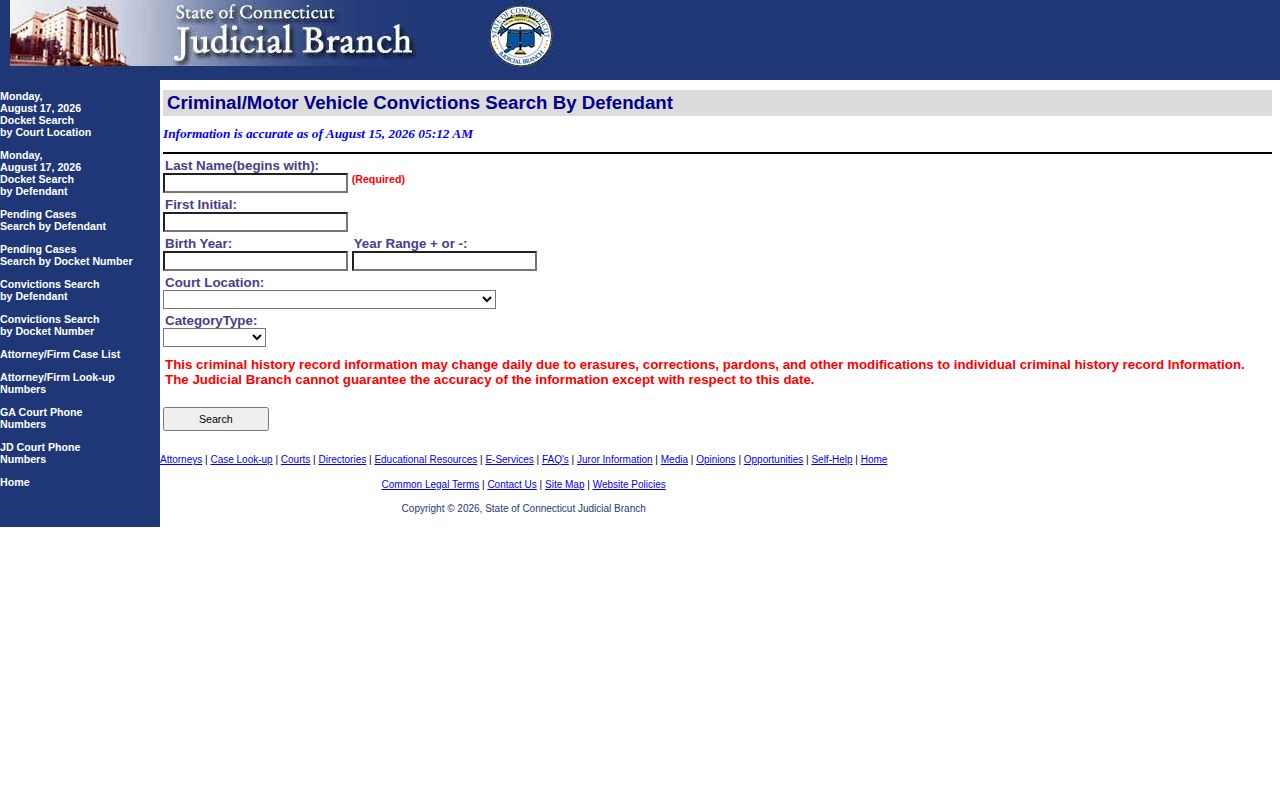
Court records can differ sharply from the booking label. One result might show a different charge. Another might show a dismissal, a nolle, an acquittal, or a conviction. Ask the G.A. 7 clerk to see the underlying paperwork. Court copies generally run $1 per page. Older disposed files sometimes sit at the Judicial Records Center instead. The arrest label is just where the story starts.
- Booking
- Police intake that records identity, charges, fingerprints, and possibly a photo.
- Arraignment
- The first court appearance where charges and release conditions are addressed.
- Bond
- Financial or nonfinancial terms tied to release while a case is pending.
- Disposition
- The court outcome, such as dismissal, nolle, acquittal, plea, or conviction.
- Detainer
- A request or legal hold affecting release to another authority.
- Erasure
- Statutory treatment that limits acknowledgment and access to qualifying records.
When Hamden Busted Dockets Appear
Timing trips people up. An arrest and its court result rarely appear online at the same moment. Connecticut's case information reflects entries through the close of the prior business day. So a brand-new HPD event can exist before any searchable docket does. Give the system its ordinary entry time. Double-check the name spelling and date of birth. Confirm the assigned court when timing matters. Hamden adult matters route to G.A. 7 at Meriden for now. Still, the docket itself controls the case.
Which Hamden Arrest Docket to Search
Ownership of records splits in two. Police hold the arrest and processing record. The court holds the prosecution file. That division explains a lot of the search structure. A station photograph comes from HPD, while a charge outcome must come from the clerk. The Judicial Branch keeps these searches apart too. It offers pending-by-defendant, pending-by-docket, conviction or disposition, and daily-docket options, and no single interface shows every stage indefinitely. Pick the one that fits your moment. For a new case, start with the pending search. Need an outcome instead? Use the disposition route. The daily docket works well for confirming a scheduled court event. When the exact charge, affidavit, ruling, or disposition truly matters, request the filed document from the clerk rather than trusting a web match. Booking labels get amended, nolled, dismissed, or resolved under other counts. So the final docket must control any account of the case.
Hamden Custody Alerts and Other Systems
VINE sends free, confidential alerts about custody status and court events. One catch exists. You may need to register twice, once under the offender category and once under offender-with-court-case, to catch both kinds of notice. It is an alert service, not a mugshot feed. It is no substitute for emergency services. For broader community and emergency notices, CT Alert covers that ground instead of person-specific arrest tracking.
Federal systems track separate populations entirely. The Bureau of Prisons locator covers federal custody going back to 1982, and it shows no public booking photo. ICE runs its own detainee locator. CT DOC leaves ICE-held people out of its public database. Neither channel is worth checking after an ordinary local arrest. The facts would have to point to a federal or immigration transfer first.
Hamden Busted Mugshots by Municipality
One municipality covers this whole map. Hamden. Whitneyville, Highwood, Spring Glen, Mount Carmel, and Centerville are neighborhoods inside the town, not booking jurisdictions with their own police departments. New Haven and North Haven sit nearby as separate municipalities, but neither counts as part of Hamden for arrest records.
The Hamden Busted Mugshots city page sticks to what HPD actually handles: local processing, the lack of a full public blotter, how to file a records request, the role of G.A. 7, and when a case moves to CT DOC. Keeping the scope tight matters here. It stops a regional third-party label from looking like an official county feed.
Public Record Search
Sponsored Results